







 |
 |
 |
 |
 |
 |
 |
 |
 |
 |
 |
 |
THE MEDITERRANEAN AWARD ART AND CREATIVITY IN MEMORY OF RYŪICHI SAKAMOTO


|
07 June 2024
 The "Mediterranean Award Art and Creativity 2024" was awarded to the memory of Ryūichi Sakamoto.
The ceremony took place in Naples at the headquarters of the United States of the World in the presence of political, institutional, religious and military authorities from various countries.
The Prize was presented by Prof. Michele Capasso to prof. Andrea Zepponi, who was delegated to receive the award.
THE MEDITERRANEAN AWARD CULTURE IN MEMORY OF KENZABURŌ ŌE
|
07 June 2024
 The "Mediterranean Award Culture 2024" was awarded to the memory of Kenzaburō Ōe.
The ceremony took place in Naples at the headquarters of the United States of the World in the presence of political, institutional, religious and military authorities from various countries.
The Prize was presented by Prof. Michele Capasso to Dr. Sandro Pezzoli, who was delegated to receive the award.
THE MEDITERRANEAN AWARD CULTURE IN MEMORY OF CHARLES SIMIC
|
07 June 2024
 The "Mediterranean Award Culture 2024" was awarded to the memory of Charles Simic.
The ceremony took place in Naples at the headquarters of the United States of the World in the presence of political, institutional, religious and military authorities from various countries.
The Prize was presented by Prof. Michele Capasso to Dr. Pia Molinari, who was delegated to receive the award.
PRESENTATION OF THE PROJECT CATALOGUE "IN VIAGGIO CON PARTENOPE
|
07 June 2024
 The preview of the catalogue of the project "In viaggio con Partenope", in which the Fondazione Mediterraneo and the United States of the World collaborated, was presented at the Istituo Comprensivo Caselli in Naples.
210TH ANNIVERSARY OF THE CARABINIERI CORPS
|
05 June 2024
 In the "Salvo D'Acquisto" barracks at Tor di Quinto, the Carabinieri Corps celebrated its 210th Foundation Anniversary, whose ceremony was sealed by the presence of the President of the Republic, Sergio Mattarella, welcomed by the Minister of Defence, Hon. Guido Crosetto, and the Commander General, Lieutenant General Teo Luzi.
The ceremony was also attended by numerous other Parliamentary and Government Authorities, members of the Magistracy, military, civil and religious authorities, as well as the General Commanders and Directors of the Police Forces of all the FIEP member countries and other delegations from foreign countries with which the Force has a relationship of friendship and cooperation.
A delegation from the "United States of the World" and the "Fondazione Mediterraneo" attended the ceremony.
In the Peace Museum in Naples - which houses the section dedicated to "The Carabinieri Corps: faithful over the centuries" - there was a direct link on the big screens with the event in Rome.The significant anniversary falls on 5 June, the date on which in 1920 the Carabinieri's flag was awarded the first Gold Medal for Military Valour for the Carabinieri's participation in the First World War.
The ceremony opened at 6.30 p.m. after the airdrop of soldiers from the Carabinieri Parachute Regiment "Tuscania" and the subsequent entry onto the forecourt of three training Regiments representing the Organisations of the Force, from the Training Regiment to the Territorial, from the Mobile and Special Regiment to the Forestry, Environmental and Agri-food Protection. This was followed by the presentation of the honours to the President of the Republic, accompanied by the Minister of Defence, the Chief of Defence Staff and the Commander General of the Carabinieri Corps, who reviewed the deployed Units.
This was followed by the speeches of the General Commander, Gen. C.A. Teo Luzi, the Chief of Defence Staff, Admiral Giuseppe Cavo Dragone and the Minister of Defence, Hon. Guido Crosetto.
LUIGI NICOLAIS VISITS THE MUSEUM OF PEACE AND THE SECTION DEDICATED TO THE SCULPTOR MARIO MOLINARI
|
03 June 2024
 Prof. Luigi Nicolais, former Minister of the Italian Republic and President of the CNR, visited the Museum of Peace and, in particular, the section dedicated to the sculptor Mario Molinari.
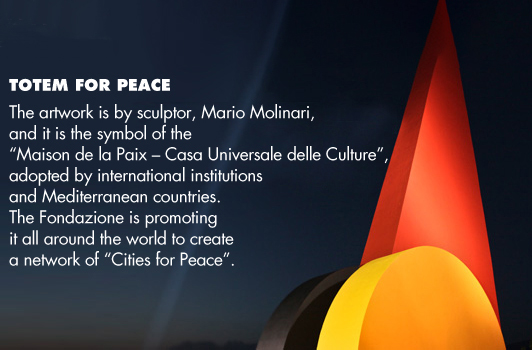
Welcomed by director Pia Molinari, he expressed his appreciation for the place and, in particular, for the works of the 'sculptor of colour' Mario Molinari, author of the Totem for Peace, symbol of the United States of the World.
THE MEDITERRANEAN AWARD ARCHITECTURE IN MEMORY OF BALKRISHNA DOSHI
|
03 June 2024
 The "Mediterranean Award Architecture 2024" was awarded to the memory of Balkrishna Doshi.
The ceremony took place in Naples at the United States of the World headquarters in the presence of political, institutional, religious and military authorities from various countries.
Secretary-General Michele Capasso emphasised the profound culture and humanity of Arch. Doshi.
The prize was presented by Prof. Michele Capasso to Prof. Massimo Pica Ciamarra, who was delegated to receive the award. The latter drew a portrait of the distinguished architect, emphasising his commitment to the needy and shared liveability.
For this occasion, an issue of the international architecture magazine "Le Carré bleu" dedicated to Doshi was reprinted.
THE MEDITERRANEAN AWARD ARCHITECTURE IN MEMORY OF ARATA ISOZAKI
|
03 June 2024
 The "Mediterranean Award Architecture 2024" was awarded to the memory of Arata Isozaki.
The ceremony took place in Naples at the United States of the World headquarters in the presence of political, institutional, religious and military authorities from various countries.
Secretary-General Michele Capasso emphasised the importance of Arch. Isozaki in contemporary architectural culture.
The Prize was presented by Prof. Michele Capasso to Prof. Pasquale Belfiore, who was delegated to receive the award. The latter drew a portrait of the illustrious architect, emphasising his role in great contemporary architecture.
PROF. MARINA MELONE RECEIVES THE MEDITERRANEAN AWARD FOR SCIENCE AND RESEARCH
|
03 June 2024
 Professor Marina Melone received the "Mediterranean Award for Science and Research 2024".
The ceremony took place in Naples at the United States of the World headquarters in the presence of political, institutional, religious and military authorities from various countries.
Secretary-General Michele Capasso emphasised Professor Melone's profound humanity in caring for patients suffering from rare diseases and her significant contribution to scientific research in the field of neurodegenerative diseases.
The Prize was presented by Prof. Michele Capasso and Prof. Luigi Nicolais, former Minister of the Italian Republic and President of the CNR.
H.E. SALIM M. ALMALIK RECEIVES THE MEDITERRANEAN AWARD INSTITUTIONS
|
03 June 2024
 H.E. Dr. Salim M. AlMalik, Director General of ICESCO (Islamic World Educational, Scientific and Cultural Organization) received the "Mediterranean Award Institutions 2024".
The ceremony took place in Naples at the headquarters of the United States of the World in the presence of political, institutional, religious and military authorities from various countries and, in particular, from ICESCO's 54 member countries.
Secretary-General Michele Capasso emphasised Dr. AlMalik's profound humanity and significant contribution to the development of ICESCO.
The Award was presented by Prof. Michele Capasso and Prof. Abdelhak Azzouzi, US Ambassador to the World, who drew a portrait of the awardee.
Present at the ceremony were Dr. AlMalik's wife, Dr. Yushra Aljaiziri, with her daughter Lana AlMalik and Prof. Luigi Nicolais, former Minister and President of the CNR.
More Articles ...
- PROF. PASQUALE BELFIORE RECEIVES THE MEDITERRANEAN AWARD FOR CULTURE
- SALIM M. ALMALIK CON LA MOGLIE YOUSRA BINT HUSSAIN AL-JAZAIRY E LA FIGLIA LANA ALLA MAISON DES ALLIANCES
- PROF. GIACOMO KOCH RECEIVES THE MEDITERRANEAN AWARD FOR SCIENCE AND RESEARCH
- YOUSRA BINT HUSSAIN AL-JAZAIRY SIGNS THE "KIMIYYA" MANIFESTO FOR WOMEN'S RIGHTS