Maison de la Paix || Casa Universale delle Culture (EN)


CASA UNIVERSALE DELLE CULTURE

The Maison de la Paix - Casa Universale delle Culture is a place strongly representative, in which will convey the knowledge of the different identities and cultures, structuring permanently initiatives aimed at the spreading of peace, necessary for the shared development.

The Maison de la Paix - Casa Universale delle Culture (MdP) is a project conceived by Michele Capasso, approved by many Countries and international organizations. It is an architecture that keeps the memory of many Peace activities which created history, often more than the wars, but it is – above all – a space "to build” Peace.

The architectonical complex has an important symbolic worth: it represents the Countries of the World engaged in the Peace process and the Countries victim of the conflicts.

Proposed by the Fondazione Mediterraneo with the Maison des Alliances – together with the main adherent organizations, such as the Mediterranean Parliamentary Assembly, the League of Arab States, the "Anna Lindh" Euro-Mediterranean Foundation and others, the MdP represents a referent point for all the ones who dedicate their lives to peace.

The symbol of the MdP is the "Totem for Peace", an artwork by the Italian sculptor Mario Molinari which the Fondazione Mediterraneo is promoting all around the world, creating the network of the "Cities for Peace".

The first seat of the MdP was inaugurated on the 14th of June 2010 (Maison de la Paix - Casa Universale delle Culture) in the historical building of the Grand Hotel de Londres in Naples.

The action of the Maison de la Paix - Casa Universale delle Culture aims at improving the main activities of the "Universal Forum of Cultures" in: Barcelona (2004), Monterrey (2007), Valparaiso (2010) and Naples (2013).

The Maison de la Paix performs most of the initiatives jointly with the Maison de la Méditerranée.


The Secretary-General, Prof. Michele Capasso, presented the "La Maison pour la Paix" project to the students – particularly those from the Faculty of Architecture – a project developed by Prof. Massimo Pica Ciamarra in collaboration with other leading architectural firms from various countries.
The project consists of a futuristic building in which the 181 countries and 16,000 civil society organisations belonging to the “United States of the World” are represented within a democratic and eco-sustainable context.

Read more: ...

A delegation from the “United States of the World” and the “Mediterranean Foundation” – comprising ambassadors, members of the International Scientific Committee and branch offices, and led by Secretary-General Michele Capasso and Director of the Museum of Peace Pia Molinari – took part in the Forum held under the High Patronage of His Majesty King Mohammed VI.
The Forum was an international event of the utmost importance and brought together eminent figures from the academic, scientific and diplomatic worlds, as well as more than 1,400 young people from 75 countries.
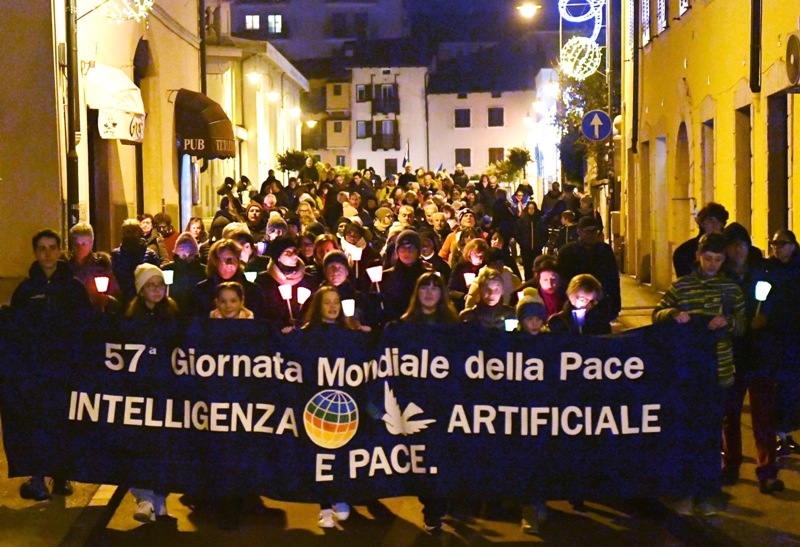
Organised by the EUROMED University of Fez and the United Nations Chair for the Alliance of Civilisations, in collaboration with the Muslim World League and the United Nations Alliance of Civilisations (UNAOC), the Forum has a strategic dimension, promoting dialogue and reflection on the profound transformations brought about by artificial intelligence.
The conference programme offered a comprehensive overview of new technologies and their role in the technological development of various countries. The aim is to conduct an in-depth analysis of the foundations of global governance of artificial intelligence, emphasising the principles of transparency, accountability and trust.
The discussions brought together experts and researchers to explore the regulatory frameworks, regulatory mechanisms and models of international cooperation needed to guide the development of AI in a rapidly evolving global context.
The work also focused on the practical applications of artificial intelligence in strategic sectors, particularly healthcare, as well as its ethical, social and cultural implications. 

Read more: ...

On the occasion of the 32nd anniversary of its inception and the 30th anniversary of the first edition of the “Mediterranean Award”, a video was shown tracing the history of the award, which is now recognised as one of the most important on the international stage.
Present at the ceremony were past and present laureates:  André Azoulay, Mohammed Kabbaj, Mostapha Bousmina, Benita Ferrero-Waldner, Senen Florensa, Miguel Ángel Moratinos, Josep Borrell, Mohammad Al-Issa, Amal El Fallah Seghrouchni, Amina Bouayach, Mohamed El Enein.
There was unanimous agreement on the establishment of the new section “United States of the World Special Edition Award”: the most prestigious award, to be presented every five years to eminent figures working for peace and social justice; the first recipients are Pope Leo XIV and the President of the Italian Republic,  Sergio Mattarella.

Read more: ...

A delegation from the “United States of the World” and the “Fondazione Mediterraneo” is taking part in the main events in Angola to mark the visit of Pope Leo XIV.
In Luanda, the Pope addresses the authorities, first of all remembering the victims of the recent floods in Benguela. He then highlights the “scars” left by the exploitation of the country, caused by predatory “overbearing interests”: “How much suffering, how many deaths, how many social and environmental disasters this extractivist logic brings with it!”. In encouraging those who have chosen goodness, justice, peace and reconciliation, Leo XIV asks local leaders not to fear dissent.
Angola is a “vibrant mosaic” and, as such, must be preserved from all predatory attempts that undermine its harmonious development, rooted in justice and brotherhood. This is the heart of the message that the Pope, having arrived in this region of southern Africa, delivers whilst speaking – following a courtesy visit to the President of the Republic, João Manuel Gonçalves Lourenço – to some 400 people, including political and religious authorities, business leaders, and representatives of civil society and culture gathered in the ceremonial hall of the Presidential Palace. An institutional gathering ‘warmed up’ first by a procession – a very colourful one indeed – which flanked the popemobile along the route, and then by a musical tribute featuring the typically slow and captivating rhythm of the kizomba.
In his address, delivered in Portuguese, the Pope focused on the unethical exploitation of the country’s resources, following the President’s welcoming remarks, in which the latter painted a troubling picture of a situation beset by what he described as “a frenzied race for raw materials, seized by force of arms by the world’s most powerful armies against sovereign nations”. For his part, Gonçalves Lourenço is keen to outline to the guest of honour the government’s efforts to promote appropriate social policies and to provide investment in water and electricity supply, as well as in ensuring housing, jobs, healthcare and education that function effectively. Aware that the challenge is complex, the President reaffirms the government’s commitment to the poorest, driven by the daily struggle against inequality, indifference and social exclusion. 
A complex and difficult challenge, indeed, at least when one considers what happened last Sunday, when the population was hit by severe floods that caused around thirty deaths and overwhelmed the infrastructure, submerging entire neighbourhoods. Over 34,000 people were forced to leave their homes. The toll was highest in Benguela, on the Atlantic coast, where 23 people lost their lives. It is to them, in particular, that the Pope’s thoughts turn, right at the start of his address.  
Leone states that the Angolan people “possess treasures that cannot be sold or stolen”. While pleased that there are still those who resist what he calls “the deception of wealth”, the Pontiff’s words nevertheless warn of the risk that joy and hope – virtues he describes as “political” – may be undermined and tainted by genuine distortions.

Read more: ...

The closing meeting, entitled “Towards a United States of Europe”, took place at the headquarters of the “United States of the World” and was coordinated by Senator Giuseppe Lumia, a founding member of the organisation.
There were many participants from federalist and voluntary movements, including Pier Virgilio Dastoli, Emanuele Alecci and Mimmo De Simone.
Speakers included Patrizia Giunti, President of the La Pira Foundation.
Secretary-General Capasso outlined the history of the United States of the World, which since 1990 has advocated the establishment of the “United States of Europe” as an inescapable necessity.

Read more: ...