Maison de la Paix || Casa Universale delle Culture (EN)


CASA UNIVERSALE DELLE CULTURE

The Maison de la Paix - Casa Universale delle Culture is a place strongly representative, in which will convey the knowledge of the different identities and cultures, structuring permanently initiatives aimed at the spreading of peace, necessary for the shared development.

The Maison de la Paix - Casa Universale delle Culture (MdP) is a project conceived by Michele Capasso, approved by many Countries and international organizations. It is an architecture that keeps the memory of many Peace activities which created history, often more than the wars, but it is – above all – a space "to build” Peace.

The architectonical complex has an important symbolic worth: it represents the Countries of the World engaged in the Peace process and the Countries victim of the conflicts.

Proposed by the Fondazione Mediterraneo with the Maison des Alliances – together with the main adherent organizations, such as the Mediterranean Parliamentary Assembly, the League of Arab States, the "Anna Lindh" Euro-Mediterranean Foundation and others, the MdP represents a referent point for all the ones who dedicate their lives to peace.

The symbol of the MdP is the "Totem for Peace", an artwork by the Italian sculptor Mario Molinari which the Fondazione Mediterraneo is promoting all around the world, creating the network of the "Cities for Peace".

The first seat of the MdP was inaugurated on the 14th of June 2010 (Maison de la Paix - Casa Universale delle Culture) in the historical building of the Grand Hotel de Londres in Naples.

The action of the Maison de la Paix - Casa Universale delle Culture aims at improving the main activities of the "Universal Forum of Cultures" in: Barcelona (2004), Monterrey (2007), Valparaiso (2010) and Naples (2013).

The Maison de la Paix performs most of the initiatives jointly with the Maison de la Méditerranée.


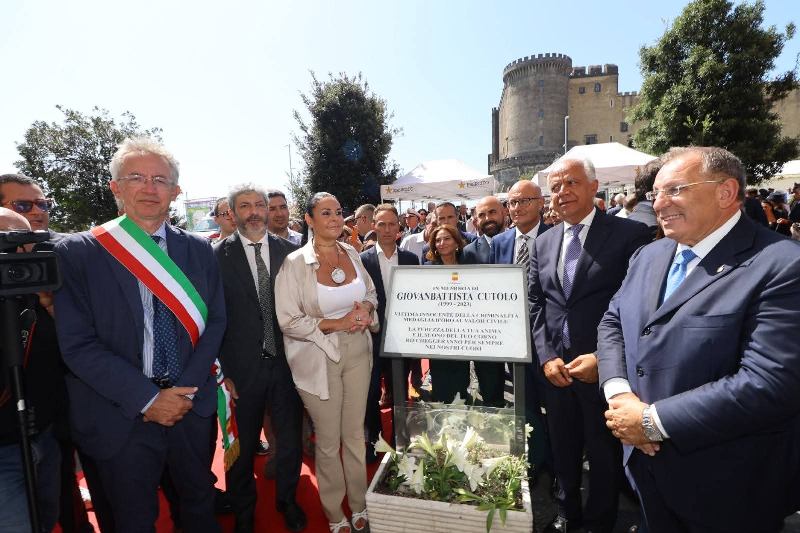
On the occasion of the 35th Anti-Mafia Summit, President Michele Capasso presented participants with copies of the books "War Journals - Bosnia" and "Raffaele, the Mayor".

Read more: ...

Jal el Dib. De la Croix Hospital. 2 December 2025. 9 a.m. The Holy Father arrives at the main entrance of the Congregation's residence by car. The nuns run to meet him and one throws her arms around his neck. Sister Marie, together with the hospital director, Sister Rose Hanna, and the superior of the convent, Sister Hiam El Badawi, accompany the Pope to the theatre, where he is given a festive welcome: the hall resounds with zaghroutah, the shouts typical of Middle Eastern women, a sign of happiness and great celebration.
Sister Marie thanks the Pontiff for his presence, which confirms God's love for the poorest of the poor, the most abandoned and the most suffering; then she recalls the founder Abouna Yakub, who said: "My religion is Lebanon and the suffering". Finally, she thanks the Holy Father once again for being "the 'father' of the forgotten, the abandoned and the marginalised".
The Holy Father receives 77 handmade rosaries from the patients as a gift, then listens to their testimonies and is moved.
"I am happy to meet you, it was my wish, because Jesus lives here: both in you who are sick and in you who care for you, the nuns, doctors, all the healthcare workers and staff", he began in French, assuring them that all the people of the Lebanese hospital are in his heart and in his prayers. The Pope also recalls the holiness of the founder's life and his testimony carried on by the Franciscan sisters.
Port of Beirut. 2 December 2025. 9.30 a.m. After the emotions of the Hospital de la Croix, we find ourselves among the rubble of the port of Beirut, where on 4 August 2020 a terrible explosion caused more than two hundred deaths, seven thousand injuries and more than three hundred thousand displaced persons, shocking Lebanon and the whole world.
Here, the Pope comes to bring comfort to a pain caused by a wound that is still open for everyone.
The Pope prays before the marble monument that bears the names of the dead, one by one. He lays a wreath and greets the survivors and the families of the victims. Everyone is holding photographs of their missing relatives. The emotion is strong. The Pope greets the families of those who lost their lives one by one, a simple gesture but one full of human closeness: he kneels in front of a child and takes the photo of his father that the little boy is holding in his hands. A mother embraces him. It is a moment of deep emotion that marks one of the most symbolically powerful moments of the Holy Father's trip to Lebanon.
Beirut Waterfront. 2 December 2025. 10.30 a.m. The impact is powerful. Thousands of people fill the esplanade overlooking the sea. The altar is housed in a large white covered structure and the Pope is surrounded by many words of “Peace” in the main languages surrounding the larger inscription “Blessed are the peacemakers”: the theme of this first Apostolic Journey.
After the celebration, Pope Leone XIV addressed this final greeting to the crowd:
“Dear brothers and sisters, during these days, with my first Apostolic Journey undertaken during the Jubilee Year, I wanted to be a pilgrim of hope in the Middle East, imploring God for the gift of peace for this beloved land, marked by instability, wars and pain.
Dear Christians of the Levant, when the results of your efforts for peace are slow in coming, I invite you to lift your gaze to the Lord who is coming! Let us look to him with hope and courage, inviting everyone to set out on the path of coexistence, fraternity and peace. Be builders of peace, heralds of peace, witnesses of peace!...".

Read more: ...

Harissa. 1 December 2025. 11:30 a.m. The Pope is captivated by the atmosphere and beauty of the Shrine, which he does not hide even when he greets those present by saying ‘Good morning’ in Arabic:
"Dear brothers in the Episcopate, priests, men and women religious, brothers and sisters, good morning! Good morning! It is with great joy that I meet you during this journey, whose motto is “Blessed are the peacemakers” (Mt 5:9). The Church in Lebanon, united in its many faces, is an icon of these words, as St John Paul II, who was so fond of your people, said."
There are many friends in the Shrine whom we are finally able to greet. Among them is the Latin Patriarch of Jerusalem, Cardinal Pierbattista Pizzaballa, who is surprised to see us on this occasion and moved by the welcome given to the Pope.
Beirut. Martyrs' Square. 1 December 2025. 4 p.m. We take our seats at the back, from where we have a striking view of the mosque in the background. The setting is spectacular: the central base with the word ‘Peace’ written in several languages, the olive tree and other details symbolising peace.
After greeting the representatives of the various religious denominations, Pope Leone XIV addresses the participants in the meeting with these words:
“Dear brothers and sisters, I am deeply moved and immensely grateful to be among you today, in this blessed land: a land exalted by the prophets of the Old Testament, who contemplated in its imposing cedars emblems of the righteous soul that flourishes under the watchful gaze of heaven...”.
Bkerké. 1 December 2025. 5.45 p.m. The Pope arrives dazed by his previous meetings but is immediately “nourished” by the “positive wave of young people” who caress him with sounds, shouts and invocations.
After listening to songs and watching dances, and after a few speeches by representatives of the young people, Pope Leone XIV reads his greeting:
“Assalamu lakum! (Peace be with you). Dear young people of Lebanon, assalamu lakum!
This is the greeting of the risen Jesus (cf. Jn 20:19) and it sustains the joy of our meeting: the enthusiasm we feel in our hearts expresses the loving closeness of God, who brings us together as brothers and sisters to share our faith in Him and our communion with one another... Let us look at the wonderful examples left to us by the saints! Let us think of Pier Giorgio Frassati and Carlo Acutis, two young people who were canonised in this Holy Year of Jubilee. Let us look at the many Lebanese saints. What singular beauty is evident in the life of Saint Rafqa, who with strength and gentleness endured years of suffering from illness! How many acts of compassion were performed by Blessed Yakub El-Haddad, helping those most abandoned and forgotten by everyone! What a powerful light comes from the darkness into which Saint Charbel decided to withdraw, he who has become one of the symbols of Lebanon in the world! His eyes are always depicted as closed, as if to hold back an infinitely greater mystery. Through the eyes of Saint Charbel, closed in order to see God better, we continue to perceive God's light more clearly. The song dedicated to him is beautiful: "O thou who sleepest, and thy eyes are light unto ours, upon thy eyelids a grain of incense hath blossomed".

Read more: ...

A delegation from the "United States of the World" and the "Fondazione Mediterraneo" participates in Pope Leone XIV's visit to this monastery, where the tomb of Saint Charbel Maklouf is located.
Heavy rain does not prevent thousands of people from crowding the roadsides and the area in front of the Monastery of Saint Maroun: a little girl in her mother's arms, holding an image of Saint Charbel in her small hands, is a touching sight.
Shouts and cries spread across the square in front of the monastery upon the Pope's arrival. He is immediately welcomed by Father Abbot Hady Mahfouz, Superior General of the Lebanese Maronite Order.
The Holy Father quickly visits the monastery and heads to the caves where the tomb of Saint Charbel is located.
After the Pope's prayer before the tomb of the holy hermit, the Father Abbot gives a greeting, saying, among other things:
"Grace upon grace: the grace of Saint Charbel, whose intercession continues to enlighten souls and spread the wonders of Heaven throughout the world; the grace of the presence of the Pope who has come to this sanctuary of silence and light to pray before the tomb of this humble hermit who was ardent with love. I welcome His Holiness and ask him to receive, on behalf of the whole Order, the assurance of our unconditional obedience, our constant prayers and our most devoted filial sentiments."
Pope Leone XIV addresses those present – including Cardinal Pietro Parolin in the front row – saying:
“Dear brothers and sisters! I thank the Superior General for his words and for welcoming us to this beautiful Monastery of Annaya. The nature surrounding this house of prayer also attracts us with its austere beauty. I give thanks to God for allowing me to come as a pilgrim to the tomb of Saint Charbel. My predecessors – I think especially of Saint Paul VI, who beatified and canonised him – would have greatly desired this."
The Pope uses a sober and essential style in his speech. It is precisely this difference that brings out the substance. The Holy Father does not present Charbel as a postcard miracle worker, but shows him as a teacher of what our world rejects: prayer, silence, modesty, poverty. Four words that cut like a living stone and speak to a Church often distracted by the superfluous.
"This visit fits into history like a stone that fits perfectly,’ says Secretary-General Michele Capasso, a devotee of Saint Charbel, "but Lebanon remains a fragile crossroads, and for this very reason it is the place where faith shows its most authentic face. Here, the Pope is not engaging in diplomacy but simply reminding the world that peace does not come from meetings but from reconciled hearts. This place gives us a clear image today: holiness does not go out of fashion and continues to shine when everything else falters. And if we want the flame lit by this stage not to go out, it is worth doing what the Pope suggested without proclamation: returning to prayer, silence and evangelical poverty. These are the only paths that truly lead to the light."

Read more: ...