Complete Lest || of events

A delegation from the “United States of the World” and the “Fondazione Mediterraneo” is taking part in the main events in Angola to mark the visit of Pope Leo XIV.
In Luanda, the Pope addresses the authorities, first of all remembering the victims of the recent floods in Benguela. He then highlights the “scars” left by the exploitation of the country, caused by predatory “overbearing interests”: “How much suffering, how many deaths, how many social and environmental disasters this extractivist logic brings with it!”. In encouraging those who have chosen goodness, justice, peace and reconciliation, Leo XIV asks local leaders not to fear dissent.
Angola is a “vibrant mosaic” and, as such, must be preserved from all predatory attempts that undermine its harmonious development, rooted in justice and brotherhood. This is the heart of the message that the Pope, having arrived in this region of southern Africa, delivers whilst speaking – following a courtesy visit to the President of the Republic, João Manuel Gonçalves Lourenço – to some 400 people, including political and religious authorities, business leaders, and representatives of civil society and culture gathered in the ceremonial hall of the Presidential Palace. An institutional gathering ‘warmed up’ first by a procession – a very colourful one indeed – which flanked the popemobile along the route, and then by a musical tribute featuring the typically slow and captivating rhythm of the kizomba.
In his address, delivered in Portuguese, the Pope focused on the unethical exploitation of the country’s resources, following the President’s welcoming remarks, in which the latter painted a troubling picture of a situation beset by what he described as “a frenzied race for raw materials, seized by force of arms by the world’s most powerful armies against sovereign nations”. For his part, Gonçalves Lourenço is keen to outline to the guest of honour the government’s efforts to promote appropriate social policies and to provide investment in water and electricity supply, as well as in ensuring housing, jobs, healthcare and education that function effectively. Aware that the challenge is complex, the President reaffirms the government’s commitment to the poorest, driven by the daily struggle against inequality, indifference and social exclusion. 
A complex and difficult challenge, indeed, at least when one considers what happened last Sunday, when the population was hit by severe floods that caused around thirty deaths and overwhelmed the infrastructure, submerging entire neighbourhoods. Over 34,000 people were forced to leave their homes. The toll was highest in Benguela, on the Atlantic coast, where 23 people lost their lives. It is to them, in particular, that the Pope’s thoughts turn, right at the start of his address.  
Leone states that the Angolan people “possess treasures that cannot be sold or stolen”. While pleased that there are still those who resist what he calls “the deception of wealth”, the Pontiff’s words nevertheless warn of the risk that joy and hope – virtues he describes as “political” – may be undermined and tainted by genuine distortions.

Read more: ...

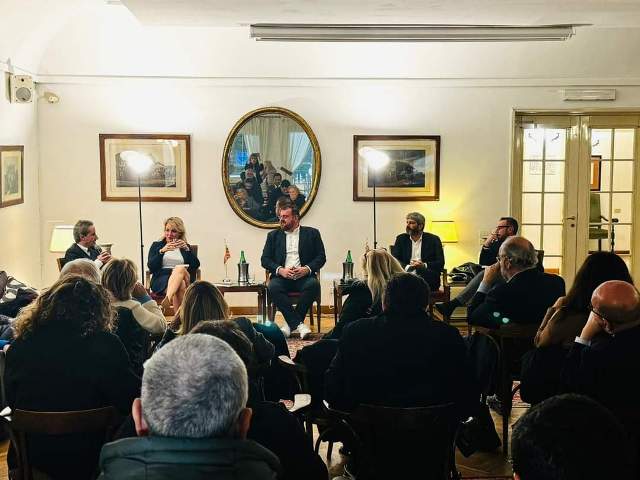
The closing meeting, entitled “Towards a United States of Europe”, took place at the headquarters of the “United States of the World” and was coordinated by Senator Giuseppe Lumia, a founding member of the organisation.
There were many participants from federalist and voluntary movements, including Pier Virgilio Dastoli, Emanuele Alecci and Mimmo De Simone.
Speakers included Patrizia Giunti, President of the La Pira Foundation.
Secretary-General Capasso outlined the history of the United States of the World, which since 1990 has advocated the establishment of the “United States of Europe” as an inescapable necessity.

Read more: ...

A delegation from the “United States of the World” and the “Mediterranean Foundation” is taking part in the main events in Cameroon to mark the visit of Pope Leo XIV. The Pope meets over one hundred thousand people representing the people of Cameroon and of that “plundered” Africa, as he himself described it, repeating Christ’s question to his disciples in the passage on the multiplication of the loaves and fishes: This is the Gospel proclaimed at Mass in Douala, the economic capital with four million inhabitants, overlooking the ocean, an hour’s flight from Yaoundé, which the Pontiff is visiting on his apostolic journey through four nations of the continent. By car, Leo XIV travels along the main road that cuts through the shanty towns that plague Africa. He passes between the wooden shacks and the families living on the barren land. Then he arrives at the “Japoma Stadium” in the “Africa Cup of Nations” sports complex, where he celebrates the Eucharist. The heat is scorching. And in the popemobile, he makes his way through the crowd amidst singing and dancing. During the liturgy, Leo XIV quotes the question from Scripture which, he says, today “is addressed to those who bear the social and political responsibility of looking after the people and their welfare”. And they have the duty to respond to the “hunger of the people” that humiliates a large part of humanity, he denounces.  “A hunger for peace, for freedom, for justice,” he is keen to emphasise. And a hunger for “food” that is “rationed in times of emergency”, “stolen in times of strife”, “wasted by those who gorge themselves whilst others have nothing to eat”. The alternative to greed is the “miracle” of “sharing”, as the Pope calls it in his homily delivered in both French and English. And he warns: “There is bread for everyone if it is given to everyone. There is bread for everyone if it is taken not with a hand that grasps, but with a hand that gives”.  
Of course, explains Leo XIV, ‘the food that nourishes the body must be combined with equal charity with the nourishment of the soul’. Because ‘many experience poverty, both material and spiritual’, he says, addressing young people. And he reserves a special word of encouragement for them: “Do not give in to mistrust and discouragement; reject all forms of abuse and violence, which deceive by promising easy gains but harden the heart and make it insensitive. Be protagonists of the future, following the vocation that God gives to each of you, without allowing yourselves to be bought by temptations that squander your energies and do not serve the progress of society’. He points to Floribert Bwana Chui as an example for them, the young Congolese man of Sant’Egidio who was martyred for opposing corruption and was the first person to be beatified during the pontificate of Leo XIV.

Read more: ...

The Council of Ambassadors of the United States of the World and the Executive Board of the Fondazione Mediterraneo have expressed their full solidarity with Pope Leo XIV, condemning President Donald Trump’s attack as unacceptable and wholly inappropriate for a representative of the Catholic faith.

Read more: ...

A delegation from the “United States of the World” and the “Mediterranean Foundation” took part in the various events during Pope Leo XIV’s visit to Algeria, in the capital Algiers and in Annaba, the city of St Augustine.
“A blessed visit” - with these words, the Pontiff thanked the Algerian authorities and the “small but significant” local Church, reaffirming the relevance of St Augustine’s message to “seek unity among all peoples and mutual respect despite differences”, and recalled his visit to the Great Mosque of Algiers: “Despite different beliefs and different ways of praying, we can live together in peace.”
The Holy Father recalled the “special visits” he made on 13 and 14 April to the Basilica of Notre-Dame d’Afrique in Algiers and to the Basilica of Saint Augustine in Annaba, on the hill overlooking the modern city and the ruins of the ancient Roman city of Hippo. According to the Pontiff, all this has “great symbolic value”, because Saint Augustine, Bishop of Hippo for more than thirty years, “is a figure from the past who speaks to us of tradition, who speaks to us of the life of the Church in the early centuries of its development”, yet, at the same time, remains an “extremely important figure even today”.
Secretary-General Capasso states: “St Augustine’s writings, teaching, spirituality, and call to seek God and the truth are the message we so desperately need in today’s world; a message that is highly relevant not only to all of us believers but also to every person.”
For a Pope who immediately declared himself a “son of Saint Augustine”, it was therefore “a special grace” to be able to return to Annaba and “offer to the Church and to the world” the vision of the great Father of the Church: “That of the search for God and the effort to build community, to seek unity among all peoples and mutual respect despite differences”.

Read more: ...